Blast ejecta |
Tektites are typically rounded black silicate glass objects, and range from less than a millimeter wide to chunks weighing several pounds. The parent material is sedimentary rock from the Earth's surface. They formed under conditions of high pressure and sudden intense heating, most likely from meteorite impacts. Areas where tektites of similar composition are found are called strewn fields. Each strewn field is thought to have been formed by a single event.
The Australasian tektite strewn field is the largest in the world, covering about 15% of the surface of the Earth. Yet no source crater has ever been found, though many have searched for it in Indochina.
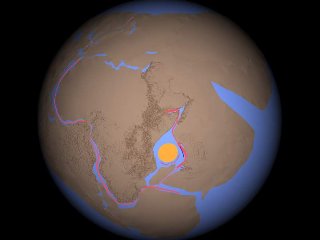
But this area is just where one would expect to find debris from a giant impact north of Madagascar and heading west to east.

From: Giuli, Gabriele, Maria Rita Cicconi, Sigrid Griet Eeckhout, Giovannie Pratesi, Eleonora Paris, Luigi Folco. 2014. Australasian microtektites from Antarctica: XAS determination of the Fe oxidation state. Meteoritics & Planetary Science, Vol. 49, No. 4, pp. 696-705 doi:10.1111/maps.12283
On the above map of the Australasian strewn field, the dashed line is the tentative boundary. Dark black asterisks are tektites on land, as are the shaded spots in Antarctica; open circles are microtektites on the ocean floor; small "x"s are core samples where no tektites were found.
Microtektites that
appear to be part of the Australasian strewn field have been
found about 3000 km south of eastern Australia, in the Victoria
Land Transantarctic Mountains of Antarctica.
Folco,
L., P. Rochette, N. Perchiazzi, M. D'Orazio, M.A. Laurenzi, M. Tiepolo.
April 2008. Microtektites from Victoria Land Transantarctic Mountains.
Geology, Vol. 36, No. 4, pp. 291-294.
Large tektites from forward jetting would fall to Earth faster than microtektites. In the Australasian strewn field, large tektites are found on land that was down range of the impact in the original protocontinent.

|
|
|
|


(Muong Nong tektites from Indochina; scale in centimeters)
Glass produced in
atomic bomb tests shares most of the characteristics of tektites,
including shape, color, transparency, inclusions of quartz
and other minerals, iron ratios, and very low water content. Even
the percentages of types of shapes are similar.
Rocca, M.C.L. 2005. Australasian tektites
and atomic bomb glass: close similarity in their shape percentages.
Meteoritics & Planetary Science, Vol. 40, Supplement, Proceedings
of the 68th Annual Meeting of the Meteoritical Society, September
12-16, 2005, Gatlinburg, Tennessee. Abstract, p. 5001.
"The largest
strewn fields originate from an approximately 30 degree impact
(more oblique impacts eject a lot of high velocity melt, but it
moves through the low, dense atmosphere, while less oblique impacts
eject melt into steep trajectories)." "Ejecta with
the highest velocity (and hence - the most distal [farthest])
originate from a very thin surface layer." If the meteorite
is small, "all ejected material is quickly decelerated by the
atmosphere; molten droplets cool quickly, and descend at the distances
of a few crater radii."
Artemieva, N. March 2008.
Tektites: model versus reality. 39th Lunar and Planetary Science
Conference, LPI Contribution No. 1391, p. 1651.
Based on chemical
analysis, "the Australasian tektite/microtektite strewn field
was formed by an impactor of primitive composition, thus either
of chondritic or primitive achondritic composition."
Folco,
L., B.P. Glass, M. D'Orazio, P. Rochette.
2018. Geochimica et Cosmochimica Acta, Vol. 222, pp. 550–568
doi:10.1016/j.gca.2017.11.017
Researchers analyzing Australasian microtektites found that they "could not match the composition of the cpx spherules with mixtures of basement rocks and overlying sedimentary deposits (for which compositional data are available) at the Popigai impact crater". – Glass, Billy, Heinz Huber, Christian Koeberl. 1 October 2004. Geochemistry of Cenozoic microtektites and clinopyroxene-bearing spherules. Geochimica et Cosmochimica Acta, Vol. 68, No. 19, pp. 3971-4006 DOI: 10.1016/j.gca.2004.02.026
Below is a map of an ash layer
overlapping or just above the microtektite layer.1
The black dots are ocean floor drilling sites where this combination
has been found. The shaded area is the presumed area covered
by the ash, estimated to be 3.7 x 10⁷
km2.
The "X" at Toba is a volcanic caldera proposed as
an ash source by some, though it is doubtful that an ash cloud would
spread both east and west. However, it does fit well with
an impact in the West Somali Basin, which would loft volcanic
ash and tektites downwind together.
1Glass, Billy P., Christian Koeberl. 2006.
Australasian microtektites and associated impact ejecta in the South
China Sea and the Middle Pleistocene supereruption of Toba. Meteoritics
and Planetary Science, Vol. 41, No. 2, pp. 305-326.

Meteorite impacts throw out clouds of melted rock droplets that solidify in the air.

Modified
from: Schultz, Peter H., David A. Crawford. July 21, 2016.
Origin and implications of non-radial
imbrium sculpture on the moon. Nature,
Vol. 535, No. 7612, pp. 391-394 DOI:10.1038/nature18278
Near a crater there are also microscopic bits of quartz blasted by high-pressure that change to coesite and shocked quartz.
So it is fitting that a clinopyroxene (cpx) spherule layer, an iridium spike, plus coesite and shocked quartz were found at Ocean Drilling Project (ODP) Site 709C in the western Indian Ocean. Deep Sea Drilling Project (DSDP) Site 216 is about 3350 km east of Hole 709C, and it also contains abundant cpx spherules and coesite. The Shock Dynamics crater is perfectly positioned north of Madagascar as the source for them as well as the other spherule layers farther east on the Pacific Ocean seafloor.

Sites
where upper Eocene impact ejecta has been found. The red stars
show the locations of large impacts in late Eocene strata.
From:
Liu, Shaobin, D. A. Papanastassiou, H. H. Ngo, B. P. Glass. 2006. Sr and Nd
analyses ofupper Eocene
spherules and their implications for target rocks.
Meteoritics & Planetary Science, Vol. 41, No. 5, pp. 705-714.

Iridium, microtektite, and cpx spherule distributions at ODP Hole 709C. Meters below sea floor = mbsf.
"The microtektites and cpx spherules at this site are so abundant that they could even be seen in a beaker prior to sieving." A micron (µm) is one-thousandth of a millimeter.


Here is a collection of spherules and fragments
from ODP Hole 709C.

Microtektites (>125 µm) from ODP Hole 709C. Most of
the microtektites are fragments.

Coesite-bearing grains from ODP Hole 709C


Shocked quartz from ODP Hole 709C.
Shaobin, Liu, Glass, B P; Kyte, Frank T; Bohaty, Steven M; Koeberl, Christian (editor); et al. 2009. The late Eocene clinopyroxene-bearing spherule layer; new sites, nature of the strewn field, Ir data, and discovery of coesite and shocked quartz. Special Paper - Geological Society of America Vol. 452, pp. 37-70. DOI:10.1130/2009.2452(04)